
Broadway's Crown Has Split Three Ways
Chicago now originates Broadway-bound work at a breadth no rival matches, San Diego runs the strongest single premiere pipeline in the country, and the road outdraws Broadway itself. New York still opens everything. It no longer starts everything, and no one city has taken the whole job.

On November 5, 2025, Purple Rain opened at the State Theatre in Minneapolis. The date and the city were the point. Prince's hometown gave his songs their world premiere as a stage musical, in a 2,000-seat road house three blocks from First Avenue, with a book by Branden Jacobs-Jenkins, a Pulitzer winner, and direction by Lileana Blain-Cruz. A production with Broadway money and Broadway intentions chose to be born in Minnesota, in front of Minnesota critics, because that is where a new musical can now afford to find out what it is.
What it found out was expensive in a different currency. The notices were mixed, and the show that eventually travels to New York will be a substantially rebuilt one: Rolling Stone reported in August 2026 that the Broadway production, due at the Majestic Theatre in March 2027, has a new director, Saheem Ali, and a new book writer, Peter Duchan, with the Prince estate's co-manager describing a leaner version of what Minneapolis saw. The premiere city bore the risk. The center kept the final say. (Our page for Purple Rain tracks the production's dates from the State Theatre to the Majestic.)
That transaction, risk exported and judgment retained, is now the standard geography of American theater. The question is who ends up owning it. Producers, critics and at least three city governments have a candidate for the next center of theater and stage. The evidence supports a stranger answer: there isn't one. The crown has split, and the pieces are in different time zones.
The push: New York prices development like a luxury good
Start with the force moving the work. The Broadway League's economic study of the 2024–25 season, released in October 2026, counted 44 new productions that cost a combined $418 million to produce, a 39% increase over 2018–19 after inflation, with an average of $9.5 million spent in New York on each show before it opened. The New York Times reported in September 2025 that none of the 18 commercial musicals that opened the previous season had made a profit, that only three new musicals have recouped since the pandemic (MJ, & Juliet and Six), and that Jason Laks, the League's president, puts the share of musicals that are now profitable at about 10%, half the historical average. Producer Tom Kirdahy told the Times that "shows that are even selling a million dollars in tickets a week can't survive."
New York is not collapsing; it set gross records in both of the last two seasons, $1.89 billion and then $1.91 billion. What has become untenable is developing work there. A workshop, a reading, a tryout production at New York prices burns the money a show needs to survive its first Broadway winter. So the development has moved to where a dollar buys a full production instead of a rehearsal room: the subsidized regional premiere, in a city with an audience trained to show up for new work. Which cities those are is a matter of record, not boosterism.
Chicago: the breadth nobody else has
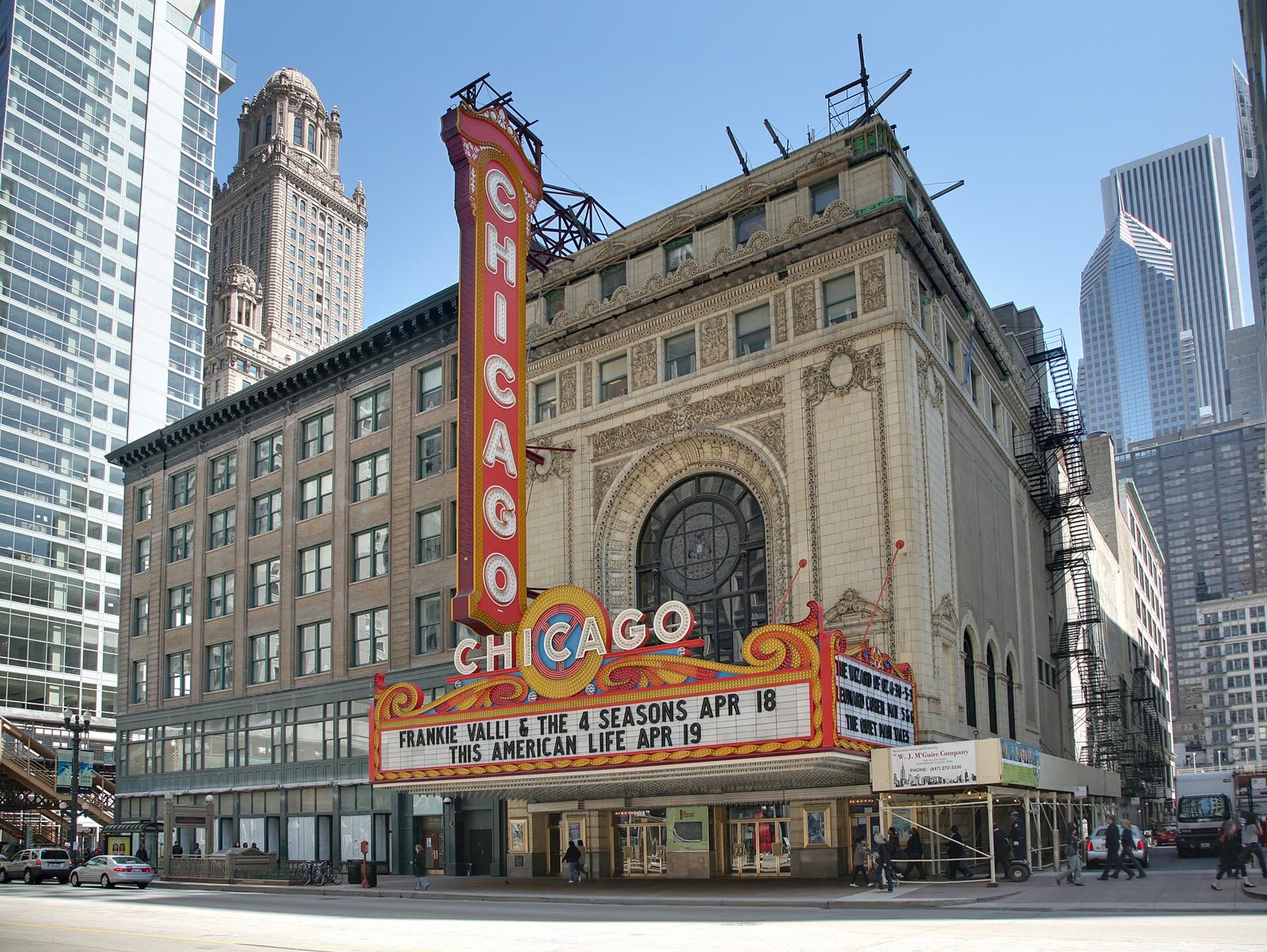
Between March 2024 and March 2025, four productions reached Broadway from Chicago premieres, and they came from three different companies. Chicago Shakespeare Theater sent The Notebook (premiered October 2022) and Illinoise (premiered February 2024, sold out, by way of the Park Avenue Armory). The Goodman sent its 2023 The Who's Tommy. Steppenwolf sent Purpose, which it commissioned and premiered on March 24, 2024. Purpose then did the two things Chicago work is not supposed to do in New York: it won the 2025 Pulitzer Prize for Drama and the Tony Award for Best Play, and it made its money back, recouping a $5.25 million capitalization. (Our Chicago desk follows all three companies; the Steppenwolf's own history is on its venue page.)
No rival city placed Broadway-bound work from more than one institution in the same period. Chicago also holds the touring structure to match, with Broadway In Chicago running five Nederlander houses in the Loop, and a storefront ecology underneath the flagships that keeps the talent base local instead of migratory.
The case against Chicago is financial, and it is documented. In 2023 Steppenwolf laid off 12% of its staff after its subscriber base fell from 10,000 to roughly 6,000 and its operating budget shrank from $20 million to $16 million. Lookingglass, another signature company, paused operations the same summer. Chicago creates like a capital and balances its books like a regional theater in a hard year, because it is one. The crown's heaviest piece sits there anyway.
San Diego: the pipeline, and the man who took it back to New York
If the test is a single institution's conversion rate, the answer is a campus on a mesa above San Diego. In Christopher Ashley's 18 years running La Jolla Playhouse, the theater oversaw 50 world premieres and shepherded 20 productions to Broadway, according to UC San Diego's account of his tenure. The recent record is the peak of it: The Outsiders, premiered at La Jolla in February 2023, opened on Broadway in April 2024, won the Tony for Best Musical, and recouped its $22 million capitalization in December 2025. Redwood followed the same route a year later. Across Balboa Park, the Old Globe operates as a second pillar, with 20 productions sent to Broadway since 1987 by its own count and three world premieres in its 2026 season. (The Outsiders is on our show pages, tour dates included.)
Then the counter-evidence, which is a person. In January 2026 Ashley left La Jolla to become artistic director of the Roundabout Theatre Company, in New York. The strongest alternative pipeline in American theater was built by a man who now runs a Broadway institution, and his first La Jolla successor will either prove the pipeline is a place or expose that it was a Rolodex. San Diego also has no touring room of the first rank to set beside its premieres. It holds the creation piece of the crown, on probation.
The road: the audience left first
The third piece is not in dispute anywhere, because the League published it. Touring Broadway drew approximately 14.9 million attendances in 2024–25, more than Broadway itself drew in New York (14.66 million) in the same season. The largest single share of that audience is not where the industry press sits. DPAC, the 2,700-seat city-owned theater in Durham, North Carolina, reported more than 600,000 guests across 258 performances in its 2025–26 season and 18,000 Broadway season members; Billboard's 2026 mid-year rankings placed DPAC first among American venues in ticket revenue. On Billboard's year-end 2025 chart, the top touring room was Atlanta's Fox Theatre, behind only the Colosseum at Caesars Palace. Toronto's Mirvish organization reports some 40,000 subscribers across its four downtown theaters, a subscription it describes as the largest in North America.
Durham creates nothing. Toronto originates little. That is precisely their evidentiary value: they prove the audience gravity that once justified the center's existence now operates independently of it. (Our venue page for the Fox Theatre covers the Atlanta room and its season.)
The rest of the field, on the same evidence
Atlanta has the strongest claim nobody makes for it. The Alliance Theatre premiered Water for Elephants in 2023 on its way to Broadway, and Maybe Happy Ending, which began at the Alliance in 2020, won the Tony for Best Musical in 2025. (Maybe Happy Ending is tracked on our show pages.) Atlanta's weakness is concentration: one producing institution, one presenting palace, two different businesses. Minneapolis pairs the Purple Rain premiere with a genuine development culture at Theater Latté Da, whose NEXT Festival workshopped Gun & Powder in 2018; as Wanted, that musical is in previews at Broadway's James Earl Jones Theatre right now, by way of a 2020 premiere at Signature Theatre outside Washington. (Wanted opens November 8.) Washington itself is disqualified by its flagship: the Kennedy Center's new leadership has announced a two-year closure beginning in July 2026 after a season of cancellations and resignations, even as its resident companies, Arena, Signature and Woolly among them, keep working. (Our Washington desk covers the resident scene.) Los Angeles, the obvious candidate on talent alone, damaged the exact function the crown requires when Center Theatre Group suspended the Mark Taper Forum in 2023 for more than a year and cut the staff that develops new work. (The Los Angeles desk has the Ahmanson and Pantages seasons.) Seattle's 5th Avenue, a premiere factory in its prime, put its building under Seattle Theatre Group's management in March 2025 and has programmed mostly revivals since. Denver's Colorado New Play Summit develops new plays seriously and sends almost none of them to New York. Houston's Alley premieres at least two new plays a season and sent Born with Teeth to the West End, the strongest Texas record by a distance. Nashville is building the container first: a 307,000-square-foot Tennessee Performing Arts Center designed by Bjarke Ingels Group, construction from 2027, opening in 2030, with no creation record yet to put inside it. Boston's American Repertory Theater perfected the tryout model a decade ago and has been quiet in this window. Las Vegas, weighed on identical terms, posts more than 300,000 attendees a season at the Smith Center and the largest performance economy in the country, and originates nothing: a residency and receiving capital, not a theater center. (Our Las Vegas desk and the Reynolds Hall page carry its season.)
The verdict, and what would change it
The evidence supports a split crown with an order of finish. Chicago is the closest thing to a successor that exists, the only contender that creates at breadth, houses touring at scale and holds an institutional bench three companies deep. San Diego holds the premiere pipeline, pending proof it survives its founder's departure. The road holds the audience, permanently, on the League's own numbers. New York holds the opening, the verdict and the money's final judgment, which is why Purple Rain's rebuild was staffed from New York even though its risk was taken in Minneapolis.
Four facts would reorder it. La Jolla's first two post-Ashley seasons: a held transfer rate makes San Diego the creation capital outright; a collapse relocates the crown to Chicago by default. A Chicago flagship recovery, or a capital project pairing its creation bench with a first-rank modern road house. The 2030 opening of the new TPAC, which would put a resident repertory company inside a top-tier touring hall in the fastest-growing big city in this survey. And New York's cost curve: one more 39% cycle and full-scale development there becomes a franchise-only activity, at which point the premiere map in this story stops being a trend and becomes the industry.
The next data points arrive on schedule. Wanted, developed in Minneapolis and premiered in Virginia, opens on Broadway on November 8, 2026. And on March 12, 2027, the rebuilt Purple Rain plays its first Broadway preview at the Majestic, sixteen months after Minneapolis heard it first. Whatever the center of American theater now is, it will be measurable that night by a simpler test: which city the audience in the room believes the show belongs to. Get the Morning Call and we will keep the count, city by city, as the seasons report in: The Morning Call.
Reporting drawn from The Broadway League's season statistics, 2024–25 economic-impact study and touring figures; The New York Times; Playbill; the Chicago Sun-Times; Rolling Stone; UC San Diego Today; Billboard venue rankings as reported by DPAC and the Hey Durham review of the year-end chart; and the published production histories of Steppenwolf Theatre Company, Chicago Shakespeare Theater, La Jolla Playhouse, the Alliance Theatre and Mirvish Productions.