
The Broadway House Itself: 41 Theatres, the Five Demolished in 1982, and the Landmark Law That Followed
Broadway is a count before it is a place: 41 houses. Five theatres were demolished in 1982 to build a hotel. The fight over those five is why most of the surviving 41 are now protected by law.
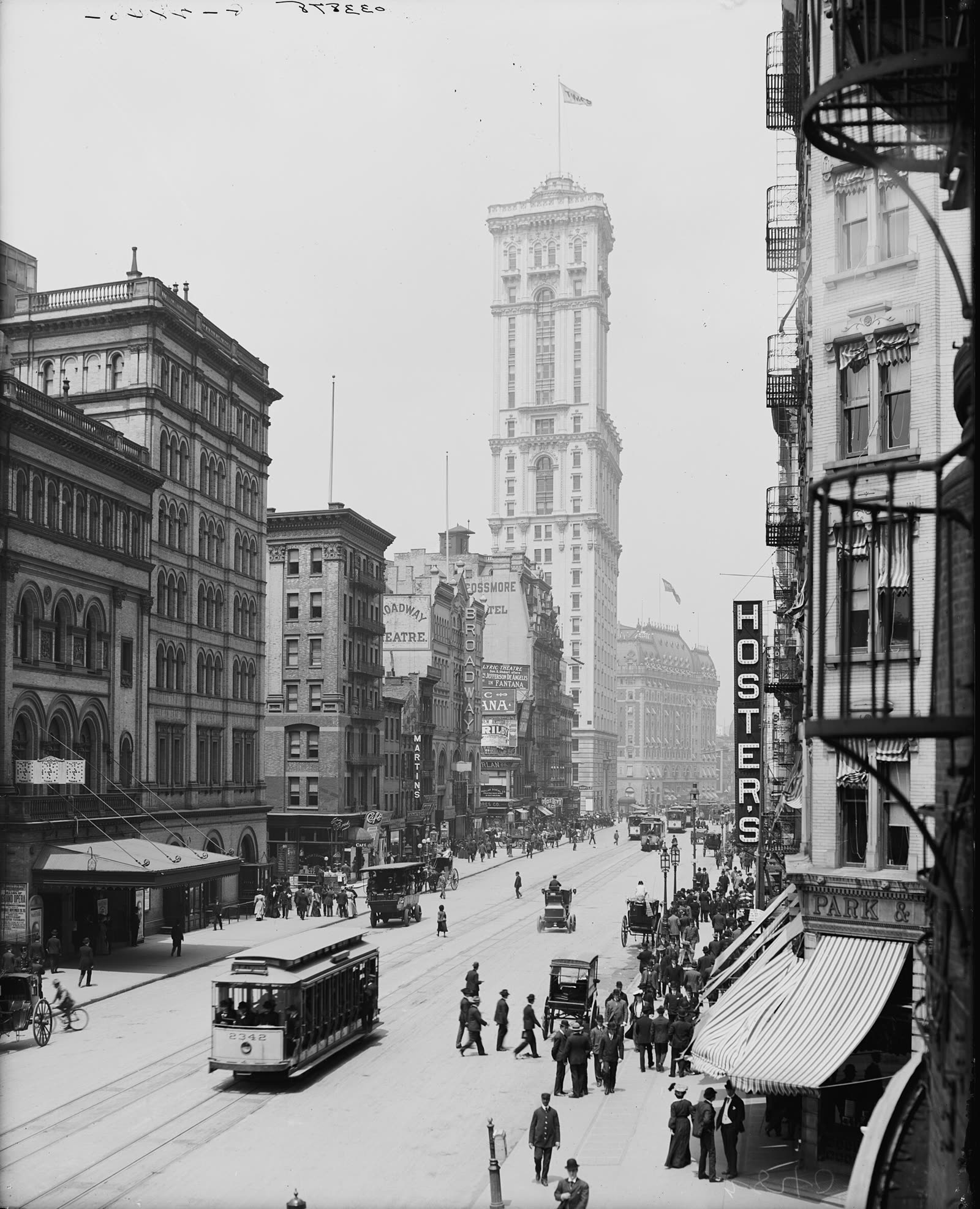
Broadway, as a category, is a count: 41 theatres. A house qualifies by size, location and the contracts it works under, which is why a building can stop being a Broadway theatre without being demolished, and why a very old building can become one again. The 41 are not a fixed estate. They are the survivors of a much larger building campaign, a demolition, and a preservation fight that changed New York law in practice.
Built fast, by a handful of names
Most of the surviving houses went up in two bursts, before the First World War and in the 1920s, as the theatre district settled around Times Square. The Hudson Theatre opened in 1903 with Cousin Kate, starring Ethel Barrymore. It was built for producer Henry B. Harris and had a lobby 100 feet long, the largest on Broadway at the time. Harris died on the Titanic in 1912. His widow, Renée Harris, ran the Hudson after him and lost it in the Depression.
The architect Herbert J. Krapp designed a large share of the houses that producers, above all the Shubert family, built in the boom. His Morosco Theatre, at 217 West 45th Street, opened on February 5, 1917, with the musical Canary Cottage. It held about 955 seats, a size that suited straight plays. On February 10, 1949, the Morosco housed the original production of Death of a Salesman. The Shuberts lost the building in the Depression; it was sold at auction in 1943 and sold again, to Bankers Trust, in 1968.
These were speculative buildings as much as temples. A theatre was a box that a producer filled, emptied and filled again, on land that kept getting more valuable whether the play inside it succeeded or not. That gap, between the value of the land and the value of the lease, is the whole story of what happened next.
The Hudson's second and third lives
The Hudson shows how a house could be lost without a wrecking ball. After its first Broadway decades it worked as a CBS radio studio in the 1930s and 1940s. NBC bought it in 1950 and ran it as a television studio. The Tonight Show, first under Steve Allen and then Jack Paar, broadcast from the Hudson in the 1950s. It returned to Broadway productions from 1960 to 1968, then spent years as an adult cinema and, from 1980, as the Savoy rock club. For a period it was a hotel conference space.
The building survived because it kept finding other uses and because, in 1987, New York City granted it landmark status, protecting both its facade and its interior. In 2015 the Ambassador Theatre Group took it on, renovated it, and reopened it as a Broadway house in February 2017 with Sunday in the Park with George, starring Jake Gyllenhaal and Annaleigh Ashford. At the reopening it was described, accurately, as both Broadway's oldest and newest theatre: opened 1903, reopened 2017.
1982: the Fallen Five
In 1973, Atlanta hotel developer John C. Portman Jr. announced a large hotel for the block that held the Morosco and the first Helen Hayes Theatre. The project stalled, then returned in 1978 when Mayor Ed Koch's administration brought Portman back as part of an effort to redevelop Times Square. The Helen Hayes and Morosco sites had been determined eligible for the National Register of Historic Places on December 26, 1978. Eligibility did not stop demolition.
A campaign called Save the Theatres, led by producer Joseph Papp and supported by actors and theatre workers, fought the hotel in court and in the street. It lost. Demolition of the Morosco and Helen Hayes began on March 22, 1982. On March 23, actors including Richard Gere, Tammy Grimes, Michael Moriarty and Treat Williams were arrested obstructing the work. On June 9, 1982, two-thirds of the Helen Hayes facade collapsed onto the street during demolition.
Five houses went down for the project in total: the Morosco, the Helen Hayes (built as the Fulton), the Bijou, and the remnants of the Astor and the Gaiety. The replacement was the Marriott Marquis hotel, which opened on September 4, 1985, with a new theatre, the Marquis, inside it. Broadway traded five old houses for one new one and a hotel.
The first Helen Hayes needs one clarification, because the name still sits on a Broadway marquee. The demolished Hayes was the former Fulton, on West 46th Street. After its demolition, the Little Theatre on West 44th Street, built in 1912 and the smallest of the older houses, was renamed the Helen Hayes Theatre. That second Hayes is the one in the current count of 41, operated today by Second Stage Theater and billed simply as the Hayes.
Landmarking: the answer the demolition produced
The preservation response came in two waves, and the dates tell the story. Three surviving houses, the Neil Simon, Virginia and Ambassador, were designated New York City landmarks on August 7, 1985, weeks before the Marriott Marquis opened. Then the city moved at scale. The Hudson's designation came on November 17, 1987. By the end of 1987, 25 Broadway theatres had been designated New York City landmarks.
Landmark status does not freeze a theatre. Interiors can be renovated, seats replaced, lobbies rebuilt. What it removes is the 1982 option: an owner can no longer convert a strong land value into a demolition permit by right. The Hudson's route back in 2017, a television studio and nightclub returned to a Broadway house under a protected shell, is the system working as intended.
The count has moved since. The Lyric was reworked in 1998 from two older 42nd Street theatres. Henry Miller's Theatre, opened in 1918, was rebuilt and reopened as the Stephen Sondheim Theatre in 2011. The Hudson's return in 2017 brought the total to the current 41.
The lesson of the record is plain. Broadway's houses were built as commercial property, and commercial property gets demolished when the land outearns the lease. What saved the surviving 41 was not sentiment. It was a legal designation, won in the five years after March 1982, house by house, starting with the three landmarked while the replacement hotel was still being finished.